
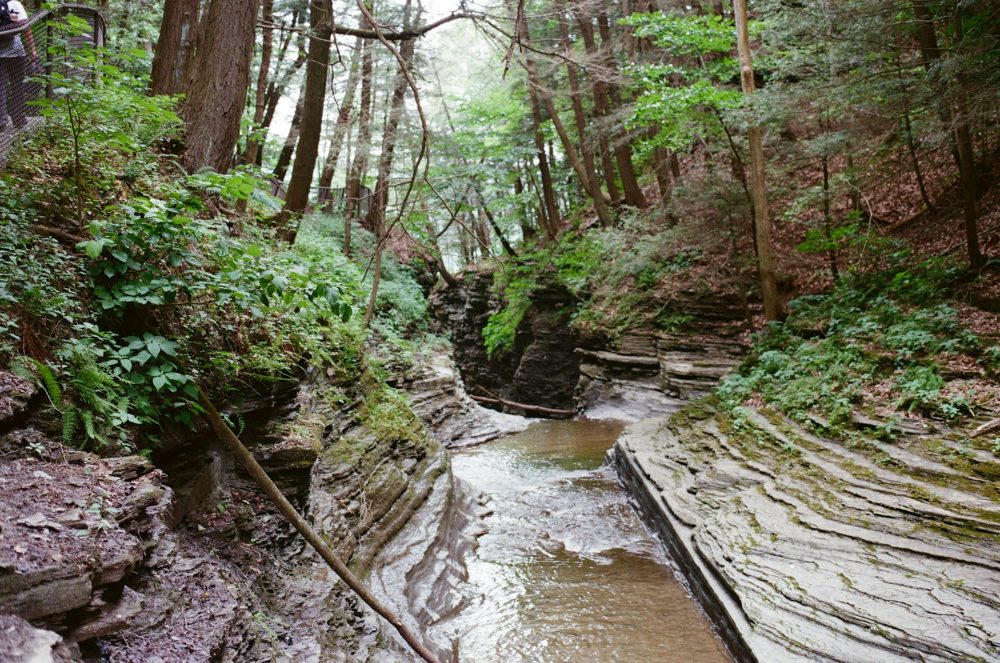
Rugged Western Pennsylvania features many popular hiking destinations that local resident Andrew Schry enjoys exploring. Among these is McConnells Mill State Park in Lawrence County, about 25 miles north of central Pittsburgh. Spanning 2,546 acres, the park encompasses much of Slippery Rock Creek Gorge, which has earned recognition as a National Natural Landmark.
Stretching about 50 miles, Slippery Rock Creek winds through the region on its way to the Beaver River. Several traditions explain how the creek earned its distinctive name. One long-standing account points to natural oil seeps that once surfaced in the gorge area, coating rocks and making them slick. Another suggests that Native Americans used shallow sandstone shelves in the creek as crossing points long before modern bridges were built. Over time, the name “Slippery Rock” was adopted by local businesses, a university, and even a township.
Oil seeps in the valley attracted attention during Pennsylvania’s early petroleum boom. By the mid-1860s, at least 17 shallow wells had been drilled along the creek. These wells produced oil for a time, until groundwater intrusion into the sandstone formations curtailed production and drilling activity shifted elsewhere. Though the oil industry eventually moved on, the geological story behind those seeps remains part of the area’s layered history.
The scenic gorge surrounding the creek features steep inclines, and the valley floor is strewn with massive boulders left behind by glacial forces and erosional processes. The park includes several overlooks, one of the best-known being Cleland Rock. This prominent outcrop provides a sweeping view of the forested valley below and serves as an important vantage point for understanding the area’s glacial past. What appears today as a dramatic rocky perch is closely tied to ancient ice advances that reshaped the landscape.
The visible bedrock in the state park dates back to the Pennsylvanian Period, roughly 300 million years ago. At that time, the region lay near the equator and was dominated by vast river systems that deposited thick layers of sand, silt, and clay. Over time, shifting river channels and floodplains created barrier sand deposits that helped form swamps rich in plant life. As vegetation accumulated and was buried, peat eventually transformed into coal. These sedimentary deposits later supported regional industries centered on iron ore, limestone (used for lime), oil, and coal extraction, fueling Western Pennsylvania’s industrial growth.
The gorge itself is largely a product of glacial activity during the Ice Age. A major ice advance reached the region roughly 140,000 years ago, damming northward-flowing streams and creating a series of glacial lakes, including the larger Lakes Edmund and Watts and the smaller Lake Prouty. At that time, the ice sheet marked the southern edge of a massive continental glacier that covered much of northern North America.
When Lake Prouty eventually overtopped the ridge near Cleland Rock, water began cutting a new spillway channel. As glacial retreat continued, drainage from Lake Watts and later Lake Edmund flowed through this developing channel, carving it progressively deeper and wider. These repeated drainage events ultimately created the gorge, which reaches depths of more than 400 feet in places. When the glaciers finally receded, the newly carved valley permanently altered regional drainage patterns, causing waters that once flowed north to flow south instead.
Today, Slippery Rock Creek continues to surge through the gorge, tumbling over boulders and forming rapids and small waterfalls that make it a favorite destination for whitewater rafters and kayakers, as well as hikers. Beyond its natural features, visitors can explore a historic covered bridge and the 19th-century gristmill that gives McConnells Mill State Park its name. For outdoor enthusiasts like Andrew Schry, the park offers not only physical challenge and scenic reward, but also a direct encounter with the immense geological forces that shaped Pennsylvania’s landscape over hundreds of millions of years.